Begin with the action, not the adjective
“Rich”, “refined” and “expensive” are difficult recording instructions. A clasp closing under light pressure, a sleeve brushing a hard edge, or a bottle landing on dense fabric gives a sound team something to investigate. Describe the action, its speed and its relationship to the camera. Then decide whether the sound should confirm the image, reveal an unseen detail or create a deliberate contrast.
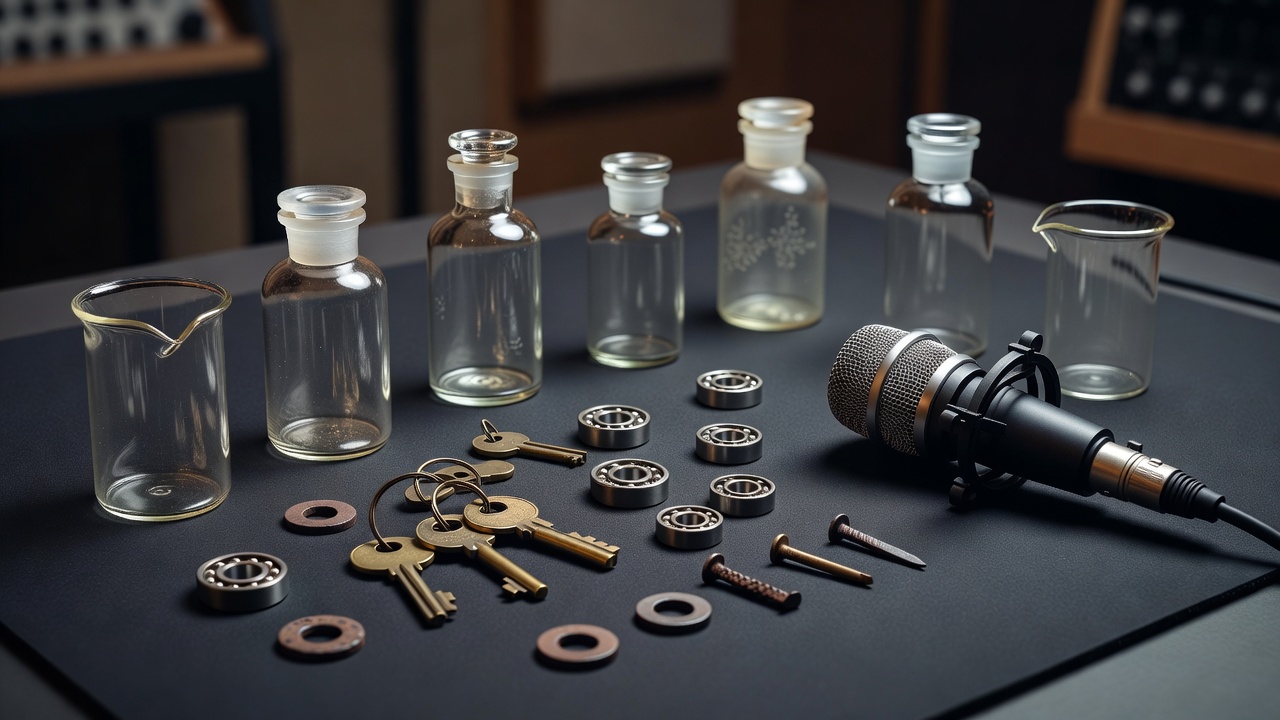
Foley is performed sound made to accompany action. Jack Foley’s association with the practice is part of film sound history, but the everyday method remains practical: experiment with objects, perform the movement and listen to what the microphone captures. The visible product is not always the most useful sound source. A substitute can work, provided it serves the intended material impression without making a misleading product claim.
Choose a listening distance
A close microphone reveals friction, tiny impacts and mechanisms that may be inaudible from the camera’s apparent position. That mismatch can be expressive, but it should be chosen. If every small movement is presented at extreme proximity, the sequence may lose its sense of scale. Establish which actions deserve intimacy and which should remain in the room.
Record more than one perspective when practical. A close take can provide definition, while a more distant take carries the action’s relationship to the space. Do not assume that adding artificial reverberation will recreate every useful feature of a room recording. Direct-to-reflected balance, early reflections and changes in performance all contribute to the result. Keep a note of microphone position so promising takes can be repeated.
Contact
What touches what? Record the support surface as deliberately as the featured object.
Movement
Does the action glide, resist, flex or release? Let the performance express that distinction.
After-sound
Listen to the ring, settling noise and room decay before deciding where the edit should end.
Build a material palette with useful limits
Try a small family of related sources rather than gathering dozens of impressive sounds. Glass, brushed metal, leather and woven cloth produce different results depending on size, finish, tension and contact. “Metallic” is not specific enough: a thin lid, a heavy hinge and a suspended plate behave differently. Photograph or describe the recording setup, and label takes by action and perspective rather than by an emotional adjective.
Vanessa Theme Ament’s The Foley Grail is a useful reference for the craft and collaboration involved. David Sonnenschein’s Sound Design offers a broader vocabulary for organising sound in a story. Use these sources to improve observation, not to justify a universal claim that one material creates one emotional response. The picture, timing and wider mix influence how the same sound is understood.
Detail earns its place when it changes how the action is understood.
Edit for intention before polish
Synchronisation matters, but alignment alone does not make an action convincing. A soft preparatory movement may need to begin before the visible contact. A resonance may need to continue across the next cut. Work with the shape of the gesture, not just a single frame marking impact. Check the sequence at normal speed before spending time on microscopic adjustments that will never be heard.
Layer only when each layer has a clear job. One might supply the transient, another the body and another the space. If several layers compete in the same range, the result can become larger but less legible. Compare the composite with its simplest version at similar perceived loudness. Otherwise the louder option may seem more convincing for reasons unrelated to the material itself.
Check the claim as well as the sound
Advertising sound can suggest qualities that deserve scrutiny. An exaggerated closure may imply a mechanism behaves differently from the real object. A substituted engine or pouring sound may alter a factual impression. Ask the responsible product and legal reviewers where expressive treatment ends and a claim begins. Keep the source and processing history available so this conversation does not depend on memory.
Finally, check the foley in context: with voice, with music, on a small speaker and at a sensible listening level. Preserve the detail that carries meaning rather than forcing every recorded nuance into the mix. Deliver organised stems with clear names and sufficient tails, alongside notes about timing dependencies. The goal is an observed physical world, not audible proof of how much work went into making it.
Next decision: make room for restraint →
Draft your sound brief